"BRITISH TELEFANTASY BEGAN IN 1963...." PART 2
by Nick Cooper © 1993-2021
1955
The six-part Return to the Lost Planet beginning on 8 January 1955 was a return to a gentler pace. This sequel had the marooned Dr McKinnon facing certain death on the icy surface of Hesikos, before encountering the gentle Hesikosians. Peter Kerr, Joan Allen and John Stuart reprised their earlier roles, as did Van Boolen, who had appeared as a barman in Nineteen Eighty-Four. Philip Hope-Wallace for The Listener stated - somewhat disturbingly - that the second episode was, "pleasantly childish, as all science fiction should be, and without last week's adult play's hysteria. Still, I bet it caused some agitation. The landing was quite thrilling."
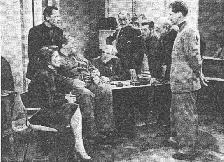 The
aforementioned adult play was The Voices, George F.Kerr's adaptation
of Robert Crane's novel Hero's Walk, televised on 16 January 1955,
with a second performance four days later. In the year 2021 the Inter Cos
world government rules the Earth and is meeting to discuss the next stage
of human space exploration. An artificial planet - 'Platform One' - already
orbits the Earth, and there are plans to construct another - 'Beta' - for
Mars, which has already been colonised. The Inter Cos President, Dr
Werner (Walter Rilla), envisages further expansion, with the full backing
of the Russian and Chinese delegates. Meanwhile, Professor Mark Harrison
(Willoughby Goddard), heavily made-up to suggest the radiation poisoning
from which he is dying, by some unexplained mental communication, is in contact
with an avenging alien force bent on punishing mankind for having over-reached
itself in its expansion away from its native planet. Werner is replaced by
the delegate for the United Kingdom and Eire, Sir Alton Berkeley (Terence
Alexander - a popular actor at the time!), and the threat recedes (in the
book it doesn't and Earth is bombed to rubble). Other notable cast members
included Kevin Stoney and Barry Letts, who went on to produce Doctor
Who in the 1970s. According to The Times, "Technicians, the
designer, and the producer, Mr Dennis Vance, took pains to make the
all-important mechanism of space taxis and vision telephones elaborately
efficient. In 2021 jackets will apparently be worn without lapels, and cigarettes
smoked as now." The Listener (as can be guessed from the previous
comment) was less complimentary: "Dennis Vance, producing, whipped the
pace to a point where one not merely did not, but could not, dwell on the
feebleness of the dialogue or stop to ponder the 'scientific' mumbo-jumbo,
yet in an hour and a half the piece induced a feeling of real contempt. If the
war of the worlds is really to be like this, we shall have died of yawning before
the first death rays sting us." The "absurd television telephones" were
condemned, and the Voices themselves, "sounded merely flatulent, at worst like
a long-playing gramophone record carelessly put on at the wrong speed."
Unfavourable comparisons were made with Nineteen Eighty-Four, but it
can be suggested that alongside that play, anything made at the time would have
been found wanting. Unfortunately, such comparisons cannot now be made
because The Voices was not recorded.
The
aforementioned adult play was The Voices, George F.Kerr's adaptation
of Robert Crane's novel Hero's Walk, televised on 16 January 1955,
with a second performance four days later. In the year 2021 the Inter Cos
world government rules the Earth and is meeting to discuss the next stage
of human space exploration. An artificial planet - 'Platform One' - already
orbits the Earth, and there are plans to construct another - 'Beta' - for
Mars, which has already been colonised. The Inter Cos President, Dr
Werner (Walter Rilla), envisages further expansion, with the full backing
of the Russian and Chinese delegates. Meanwhile, Professor Mark Harrison
(Willoughby Goddard), heavily made-up to suggest the radiation poisoning
from which he is dying, by some unexplained mental communication, is in contact
with an avenging alien force bent on punishing mankind for having over-reached
itself in its expansion away from its native planet. Werner is replaced by
the delegate for the United Kingdom and Eire, Sir Alton Berkeley (Terence
Alexander - a popular actor at the time!), and the threat recedes (in the
book it doesn't and Earth is bombed to rubble). Other notable cast members
included Kevin Stoney and Barry Letts, who went on to produce Doctor
Who in the 1970s. According to The Times, "Technicians, the
designer, and the producer, Mr Dennis Vance, took pains to make the
all-important mechanism of space taxis and vision telephones elaborately
efficient. In 2021 jackets will apparently be worn without lapels, and cigarettes
smoked as now." The Listener (as can be guessed from the previous
comment) was less complimentary: "Dennis Vance, producing, whipped the
pace to a point where one not merely did not, but could not, dwell on the
feebleness of the dialogue or stop to ponder the 'scientific' mumbo-jumbo,
yet in an hour and a half the piece induced a feeling of real contempt. If the
war of the worlds is really to be like this, we shall have died of yawning before
the first death rays sting us." The "absurd television telephones" were
condemned, and the Voices themselves, "sounded merely flatulent, at worst like
a long-playing gramophone record carelessly put on at the wrong speed."
Unfavourable comparisons were made with Nineteen Eighty-Four, but it
can be suggested that alongside that play, anything made at the time would have
been found wanting. Unfortunately, such comparisons cannot now be made
because The Voices was not recorded.
On 30 January 1955 the Kneale/Cartier/Learoyd team came up with The Creature, in which an expedition led by Dr John Rollason (Peter Cushing) travels to a remote monastery in Tibet on a quest to find the Yeti (at the time there was renewed interest in its possible existence in 'the real world' following the conquest of Everest in 1953). Given the success of Nineteen Eighty-Four, the new play was expected to be almost as much of a sensation, but in the end it was no such thing. While every effort had been made to create a genuine Himalayan atmosphere, the play was evidently let down by the lack of conviction in the performances - including those of Cushing and Stanley Baker (as Tom Friend) - and the shortcomings of the script, and even the yeti themselves were judged less than convincing. The play was repeated on 3 February, and although neither performance was telerecorded, Hammer made a film version in 1957 as The Abominable Snowman. Of the original cast, only Peter Cushing and Arnold Marlé (as the Lama of the Rong-ruk Monastery) reprised their roles, and while Kneale evidently polished his script up somewhat, it was again partially let down by the production values.
The same by and large - cannot be said of the only other Telefantasy offering of 1955, the six episode Quatermass II serial beginning on 22 October. Professor Quatermass again saw off an alien threat to the Earth (aided and abetted at one point by Roger Delgado, later to appear as the Master opposite Jon Pertwee), and this time round each week's live installment was telerecorded for a repeat a few days later, and subsequently preserved in the BBC Archives. A heavily edited Episode 3 (The Food) was screened during BBC2's The Lime Grove Story to celebrate the closing of the studios on 26 August 1991.
1956 - 1959
After the glut of Telefantasy in the first half of the decade, things settled down a bit for the last four years. The children's serial Space School occupied four weeks of 1956 from 8 January onwards. Produced by Kevin Sheldon, who had been responsible for the earlier Lost Planet stories, it was about the three Winter children (sadistically named Wallace, Winifred and Wilfred!) who "live in one of the little houses on the inside rim of Earth Satellite One," while their father is away surveying Mars. John Stuart (who had appeared in The Lost Planet as Dr McKinnon) played Space Commodore Hugh Sterling, and the cast also included Edmund Warwick, later to play the William Hartnell's double in the 1965 Doctor Who story The Chase. Unsurprisingly, the serial was not recorded, which is probably a blessing.
Viewers looking for more effective entertainment had to wait until 5 December 1957 for Evelyn Frazer's The Critical Point, which left J.C.Trewin (writing in The Listener), "afraid to approach a refrigerator." Doctors Philip Gage (Eric Lander) and Andrew Mortimer (Leo McKern) have been experimenting with "hibernation anaesthesia," first with chimpanzees, but now having reached a stage where freezing a human can be attempted. When Gage kills his wife, Margot (Nicolette Bernard), he quickly volunteers for the sort of cooling off that Adam Adamant was later seen to be trapped in very much against his will. Enter Detective Inspector Snaith (Tom Chatto), bent on feeling the good doctor's collar, only to be told: "Dr Gage is at present enclosed in a tank full of solidified gas at a temperature of minus 80 degrees centigrade." "That sounds pretty cold to me," murmurs the Inspector, obviously unaccustomed to finding his suspects in tanks of solidified gas. In the end McKern's character arranges a "mercy-killing" to spare his colleague the indignity of a trial. The play was judged a success given that, "if its treatment had been less determined, it could have been the frozen limit, but Miss Frazer had written it ably, and Leo McKern, Eric Lander, and the others acted with so much absorption that it would have been ungenerous not to join the fun." Sadly, the performance was not recorded, but producer George R.Foa remounted the play three years later with a new cast, and that version does survive (see below).
 22
December 1958 saw the first episode of the third and most successfully ambitious
of Nigel Kneale's Quatermass serials, Quatermass and the Pit.
Chillingly unfolding over six weeks, it follows the discovery of the remains
of a Martian space craft, millions of years old, during excavations for a
new office block in central London. The series was repeated in two ninety
minute compilations in 1960, and the single episode three (Imps and
Demons) was screened by BBC2 during its TV50 celebration in 1986.
An effective three hour BBC Video edited with the co-operation of
Nigel Kneale was released two years later. In a lighter vein
was Douglas Cleverdon's adaptation of H.G.Wells' short story, The Truth
About Pycraft (10 March 1959), with the lead character's feats of levitation
particularly impressing viewers.
22
December 1958 saw the first episode of the third and most successfully ambitious
of Nigel Kneale's Quatermass serials, Quatermass and the Pit.
Chillingly unfolding over six weeks, it follows the discovery of the remains
of a Martian space craft, millions of years old, during excavations for a
new office block in central London. The series was repeated in two ninety
minute compilations in 1960, and the single episode three (Imps and
Demons) was screened by BBC2 during its TV50 celebration in 1986.
An effective three hour BBC Video edited with the co-operation of
Nigel Kneale was released two years later. In a lighter vein
was Douglas Cleverdon's adaptation of H.G.Wells' short story, The Truth
About Pycraft (10 March 1959), with the lead character's feats of levitation
particularly impressing viewers.
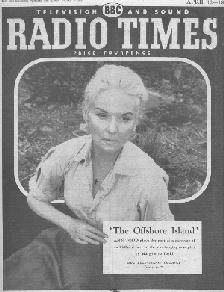 A production
which seemed at the time to rival Nineteen Eighty-Four in terms of
controversy was The Offshore Island, a condensed version (by Michael
Voysey) of Marghanita Laski's 1954 debut play, produced by Dennis Vance and
designed by Barry Learoyd. Eight years after a nuclear war has reduced much
of Europe to a wasteland, Rachel Verney (Ann Todd) and her two teenage children,
James and Mary (Tim Seely and Diane Clare), live in isolated tranquility
in a valley which - due to a freak topographical effect - has escaped the
ravages of fallout and war (a device later used in Anthony Gardner's Z
for Zachariah for Play for Today in 1984). Their peace is disturbed
by the arrival of a patrol of American soldiers, who tell them that the war
is still going on and that rather than being there to help, they have come
to transport the family to a relocation camp in the United States, where
they can work for the war effort and all their needs will be provided for.
It turns out, however, their motives are not so benevolent. Considered
'Contaminated Persons,' they will be sterilised to prevent them having mutated
offspring, after their land has been destroyed with a small tactical nuclear
device. A Russian patrol arrives and it transpires that although there is
a truce between the two sides - so that they can join forces against China!
- this will not affect the fate of the Verneys, with James eventually being
shot by the American Captain (Phil Brown) and Rachel and Mary electing to
remain in their home, waiting for the bomb. Somewhat predictably given the
subject matter, reactions to the play were firmly split along party lines.
The Times observed: "Miss Laski seems to have written it more in an
excess of public-spirited zeal than out of any creative urgency. Like Mr
J.B.Priestley in Doomsday For Dyson [an anti-nuclear ITV play shown
the year before], she comes to grind her axe about the Bomb. From [the arrival
of the Russians] the play becomes a duologue between humanity and politics;
and it is conducted with a dishonesty that identifies political man with
the stock image of the tail-wagging jargon-ridden American." On the other
hand, Ivor Brown (writing in The Listener) countered: "Whether Miss
Laski was being fair to American servicemen (with Pentagon politics behind
them) I do not know. But surely there is a case for welcoming in television
drama occasional approaches to the greatest problem in the world's history,
about which nobody with any spark of failing can fail to be in some way
tendentious. Complete objectivity in such a case is either impossible or,
if possible, dull. The Offshore Island was not written for the industry
of entertainment. Dennis Vance's production had an excellent urgency and
vigour."
A production
which seemed at the time to rival Nineteen Eighty-Four in terms of
controversy was The Offshore Island, a condensed version (by Michael
Voysey) of Marghanita Laski's 1954 debut play, produced by Dennis Vance and
designed by Barry Learoyd. Eight years after a nuclear war has reduced much
of Europe to a wasteland, Rachel Verney (Ann Todd) and her two teenage children,
James and Mary (Tim Seely and Diane Clare), live in isolated tranquility
in a valley which - due to a freak topographical effect - has escaped the
ravages of fallout and war (a device later used in Anthony Gardner's Z
for Zachariah for Play for Today in 1984). Their peace is disturbed
by the arrival of a patrol of American soldiers, who tell them that the war
is still going on and that rather than being there to help, they have come
to transport the family to a relocation camp in the United States, where
they can work for the war effort and all their needs will be provided for.
It turns out, however, their motives are not so benevolent. Considered
'Contaminated Persons,' they will be sterilised to prevent them having mutated
offspring, after their land has been destroyed with a small tactical nuclear
device. A Russian patrol arrives and it transpires that although there is
a truce between the two sides - so that they can join forces against China!
- this will not affect the fate of the Verneys, with James eventually being
shot by the American Captain (Phil Brown) and Rachel and Mary electing to
remain in their home, waiting for the bomb. Somewhat predictably given the
subject matter, reactions to the play were firmly split along party lines.
The Times observed: "Miss Laski seems to have written it more in an
excess of public-spirited zeal than out of any creative urgency. Like Mr
J.B.Priestley in Doomsday For Dyson [an anti-nuclear ITV play shown
the year before], she comes to grind her axe about the Bomb. From [the arrival
of the Russians] the play becomes a duologue between humanity and politics;
and it is conducted with a dishonesty that identifies political man with
the stock image of the tail-wagging jargon-ridden American." On the other
hand, Ivor Brown (writing in The Listener) countered: "Whether Miss
Laski was being fair to American servicemen (with Pentagon politics behind
them) I do not know. But surely there is a case for welcoming in television
drama occasional approaches to the greatest problem in the world's history,
about which nobody with any spark of failing can fail to be in some way
tendentious. Complete objectivity in such a case is either impossible or,
if possible, dull. The Offshore Island was not written for the industry
of entertainment. Dennis Vance's production had an excellent urgency and
vigour."
1960
A complete change of pace arrived on 7 February 1960 with Hands Across the Sky, the world's first (and only, until 1992's The Vampyr, that is) Telefantasy opera, composed by Anthony Hopkins. Professor Neutron (Eric Shilling) is devoted to his assistant, Miss Fothergill (Julia Shelley), but she is only interested in science. Until the arrive of the green-skilled alien Squeg (Stephen Manton), that is. The resolution to this menage-a-trois involved magic potions from Dr Jekyll's recipe book! Critical reception was good, although one does wonder with a libretto (by Gordon Snell) which included lines such as:
"I chased him through the uranium deposit,
And now he's locked himself in the heavy water closet."
According to The Listener: "Television accommodated the opera with no trace of strain. Voices and accompaniment were well balanced, and Charles Lefeaux's production had a visual inventiveness that never did violence to the formal structure." No copy is known to exist.
On 31 July 1960, George R.Foa produced a remount of 1957's The Critical Point in the Summer Theatre series. Owen Holder played Dr Gage, with Mervyn Jones as Dr Mortimer, Edward Harvey as Inspector Snaith, and Lana Morris as Margot Gage. Of the revival, The Times said: "If the play is somewhat heavily wordy and its answer melodramatic (we must admit the situation to be provocative of melodrama), Mr Foa, with keen concentration upon complex scientific processes, generated enough tension to make extremes of behaviour seem inevitable." The 35mm telerecording from which the play was transmitted is retained by the BBC, although John Cura provide off-screen photographs from the serial to The Listener (he similarly recorded many now-lost Doctor Who stories).
1961
What Quatermass did for the 1950s, A for Andromeda and its sequel did for the 1960s. Intelligently written by Fred Hoyle and John Elliot, the first six-part story began on 3 October 1961, and while transmitted from telerecordings rather than live, only film sequences from episode 2 and the last two reels of episode 6 survive (see above).
While A for Andromeda was still running, the BBC presented a 75 minute adaptation by William Best and Donald Bull of Patrick Marsh's Breakdown novel on 5 November 1961 as part of the Sunday Night Play strand. In The Test, Dr John Armstrong (Nicholas Selby), is engaged on defence work involving forces of appalling power, and grave fears of a miscalculation - with terrifying consequences - are added to the considerable strain he is under over his turbulent private life, his wife, Mary (Sheila Ballantine), having fallen in love with a colleague. The Times thought Alan Bromly's production, "though never failing to interest us, did not hold us spellbound or make us feel that human emotions were under any greater strain than usual as a result of the dangerous forces involved." While in Number Three (1953) the subject of the scientist's researches was the raison d'étre of the play, The Test was essentially a study of one man's mental breakdown, with the science-fiction elements a mere cipher - he could just as easily have been the stressed-out designer of a new (conventional) aircraft, for example. No copy is known to exist, although John Cura did take a set of off-screen photographs.
The week after A for Andromeda finished (21 November 1961), it was replaced in the schedules by the five-part The Escape of R.D.7, written by Thomas Clarke from an idea by James Parish. Dr Anna Hastings (Barbara Murray) has developed a virus (the R.D.7 of the title) which is hoped can be used against rats, but when lab cleaner Peter Warner (Roger Croucher) is infected, she is ordered to stop her experiments. Somewhat irresponsibly, she drugs her assistant and hides away with him in a remote part of Essex to carry on her experiments, first by injecting herself with R.D.7! Produced by Thomas Ormerod, the serial was reasonably well-received, with Clarke's script and characterisation being particularly praised, although The Times suggested that, "all of Mr Clarke's women characters are so unpleasant one might suspect him of misogyny." The serial does not exist in the BBC Archives.
1962
The plot of The Big Pull (from 9 June 1962) contained shades of The Quatermass Experiment, with American astronaut Mike Sklorski (Frank Fenter) returns to Earth after a single orbit, only to drop dead of unknown causes the moment the capsule is opened. The first man to enter the capsule is its designer, Dr Weatherfield (Felix Deebark), who then appears to absorb Sklorski's memory before later disappearing. The potential menaces becomes apparent when there are a series of similar 'fusions', when of two men attacked, one dies and the other vanishes. This was an early association with Telefantasy for producer Terence Dudley, later to work on Doomwatch, Survivors and Doctor Who. It was the first BBC Telefantasy to be transmitted from video tape, but unfortunately none of the six episodes survive.
Shown as part of the Suspense series on 25 June 1962, Virus X came from the pen of Evelyn (The Critical Point) Frazer. A super-flu virus is spreading across the country and the only man who can help is the embittered Dr Bennett (George Colouris), who's wartime research might hold an answer. Unfortunately, Bennett has disappeared, and the entire stock of the wonder drug he developed in the 1940s is on that very day on its way to be destroyed. Cue taut chase drama... Stephen Harrison produced/directed the hour-long play - which was not preserved by the BBC - in which Catweazle and Robin of Sherwood creator Richard Carpenter played Dr Lowden.
The six-episode The Andromeda Breakthrough began three days later. Again written by Hoyle and Elliot, it was not as immediately popular as its prequel, although the telerecordings from which all six episode were transmitted still exist.
Somewhat bizarrely, the story of the four-part serial The Monsters was worked out over lunch in the BBC Canteen the day after watching a Panorama report on the Loch Ness Monster. It reunited Evelyn Frazer and George R.Foa, who had worked together on The Critical Point, with Vincent Tilsley sharing the writing chores. On honeymoon on the banks of Lake Kingswater, Professor John and Felicity Brent (William Greene and Elizabeth Weaver) encounter strange goings on at the long-fabled haunt of mysterious creatures. Why does Professor Cato (Robert Harris) have a miniature submarine? Why has he been using it to make people believe there are monsters in the Lake? Do the monsters exist at all? Brent discovers that they do, and the fate of mankind resist on their survival. The serial was directed by Mervyn Pinfield, later associate producer and some-time director on Doctor Who. No episodes were retained by the BBC.
A hark-back to a gentler age was an adaptation of Oscar Wilde's The Canterville Ghost televised the night before Christmas Eve 1962 in its Saturday Night Play slot. Bernard Cribbins played the ghost, with Ruth Dunning and Oliver Fox the American couple who shatter the tranquil peace of his haunting by buying "his" stately home and moving in with their daughter (Samantha Eggar) and her odious twin brothers. The Times thought Elaine Morgan's script, "provided a feasible pastiche of the Master's style in her prologue and epilogue, though her efforts failed to ring true in other passages. Mr Bernard Cribbins had little to do except submit to trick photography. Mr Stuart Burge's production, when not insisting over-emphatically upon the Ghost's transparency, nicely captured the story's period."
1963
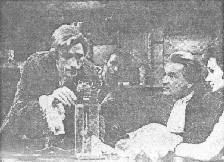 "Do
ghosts and science belong together in the same play?" asked Nigel Kneale in his
Radio Times piece accompanying his play The Road, directed
by Christopher Morahan and produced by John Elliot, and screened in the BBC
First Night series on 29 September 1963. In 1770 country squire Sir
Timothy Hassell (James Maxwell) dabbles in 'natural philosophy', while his
wife Lavinia (Ann Bell) flirts with Gideon Cobb (John Phillips), sub-Johnsonian
iconoclast of the London coffee houses. Hassell is fascinated by the search
for new knowledge, but he is a prisoner of his age, seeking at random, even
in matters supernatural. Cobb has a great and glittering vision, of how the
world should be, when, "machines will do all." What has brought them together
is the strange phenomenon which occurs in the local wood every year on Michaelmas
Eve. Three years ago, a poacher died from the horror of what he saw; the
year before Sam Towler (Rodney Bewes) almost went the same way, after hearing,
"all screams and screeching... as if all the dead people was risin' out o'
Hell an' coverin' the land!" Hassell thinks it is a haunting from the
past of the retreat of Queen Boadicea and her army with the Romans at the
heels, and sets out to prove it. But the shocking and terrifying conclusion
show it to be a pre-echo from a future two hundred years hence, when a great
road will have been built over the wood, a road down which thousands
will flee from a nuclear attack. In this sense - and even more so than
the atomic dramas of the 1950s - The Road reflected its time, when
the world had only just stepped back from the brink of thermonuclear war
during the Cuban missile crisis the previous year. To the eternal shame of
the BBC, no copy of this excellently-written drama was preserved.
"Do
ghosts and science belong together in the same play?" asked Nigel Kneale in his
Radio Times piece accompanying his play The Road, directed
by Christopher Morahan and produced by John Elliot, and screened in the BBC
First Night series on 29 September 1963. In 1770 country squire Sir
Timothy Hassell (James Maxwell) dabbles in 'natural philosophy', while his
wife Lavinia (Ann Bell) flirts with Gideon Cobb (John Phillips), sub-Johnsonian
iconoclast of the London coffee houses. Hassell is fascinated by the search
for new knowledge, but he is a prisoner of his age, seeking at random, even
in matters supernatural. Cobb has a great and glittering vision, of how the
world should be, when, "machines will do all." What has brought them together
is the strange phenomenon which occurs in the local wood every year on Michaelmas
Eve. Three years ago, a poacher died from the horror of what he saw; the
year before Sam Towler (Rodney Bewes) almost went the same way, after hearing,
"all screams and screeching... as if all the dead people was risin' out o'
Hell an' coverin' the land!" Hassell thinks it is a haunting from the
past of the retreat of Queen Boadicea and her army with the Romans at the
heels, and sets out to prove it. But the shocking and terrifying conclusion
show it to be a pre-echo from a future two hundred years hence, when a great
road will have been built over the wood, a road down which thousands
will flee from a nuclear attack. In this sense - and even more so than
the atomic dramas of the 1950s - The Road reflected its time, when
the world had only just stepped back from the brink of thermonuclear war
during the Cuban missile crisis the previous year. To the eternal shame of
the BBC, no copy of this excellently-written drama was preserved.
The landmarks of BBC Telefantasy mirror the times in which they were made quite effectively. 1938-1952 were years of innocence, with even R.U.R. offering a romanticised conquest of humanity - a far cry from the cold mechanised nightmares of later decades. 1953-1962 dealt more directly with the emerging concerns over the threats to the planet which the nuclear age had brought, yet the conviction remained that sanity would prevail and often the scientists - who had created the threats in the first place - would save us all. The early sixties saw the true loss of innocence, illusions being shattered left, right and centre, and the worst was yet to come. Almost in response, television drama stepped back from this - issues were dealt with, but in a fare more allegorical form. A planet destroyed by nuclear fire would be shown, but it wouldn't be ours, or else it would be set firmly and "safely" in the future; totalitarian regimes would reign, but only in a sense of "this could have happened," rather than, "this might still happen." It was almost as if the real life had become far worse than anything a dramatist could envisage.
At 12 seconds after 12.30 US Central Standard Time on 22 November 1963, six shots rang out in Dealey Plaza, Dallas. Things would never be the same again....
With thanks to Keith Topping for research assistance.
"British Telefantasy Began in 1963...." Part 1
[A shorter version originally appeared in DWB/Dreamwatch Bulletin #117, September 1993]
| 04/05/98 | First AOL upload |
| 17/05/98 | Additional text |
| 12/06/98 | Minor corrections |
| 21/06/98 | Images added/minor corrections |
| 28/06/98 | Images added/minor corrections |
| 09/02/99 | First Virgin Net upload |
| 21/10/99 | Transferred to 625.org.uk |
| 22/10/17 | Hosting transfer & amendments |
| 13/08/21 | Corrections |
| 14/08/21 | Corrections |